Sunday, July 16, 2023

THAT HOTEL PROPOSAL ON THE WAY TO THE CATARACT GORGE

.

LINKS [ 1 ] - [ 2 ]

IN the Launceston's recent history this 'place' is bound to go down as one of the city's most contested sites. AND the saga seems to be going on for some time yet. There is the amenity of a CULTURALlanscape that is stake and there is already collateral damage to a HOMEplace and a business. 

On the evidence 'the planning process' has paid little to no attention to what loss amenity is being put at risk or to who will bear the cost. 

The City of Launceston approved a Development Application for a $50m, 145-room hotel on Paterson Street's TRC site

The 'Gorge Hotel' proposed by the JAC Group would include a restaurant, bar, conference facilities, and retail space, and would be developed over two stages. 

Reportedly, the JAC Group plans to on sell the development opportunity which adds another layer of contention to this development.

Launceston's them Mayor Albert van Zetten said the project would be a 'fantastic' asset for Launceston but he didn't articulate by what criteria he measured fantastic – fantastic for who, when and why is still being contested

Local governance 'business' is almost exclusively to do with 'placemaking' and right here, there is an exemplar of that and those who have thus far experienced collateral damage in the process continue to hurt.

"A $50m investment in our city boasting both high quality hotel accommodation and conference facilities is something we know there is increasing demand for," Mayor van Zetten said. 

 "It's an exciting project, will be great for visitors to Launceston, and is going to take advantage of a location that has arguably been underutilised in the past, with fantastic views of the estuary.

 "The design of the building itself is unique, and will offer five star accommodation options in Launceston within walking distance to the Cataract Gorge.

 "It will play an important role in Launceston's growing tourism industry going forward, and I'm thrilled the JAC Group has decided to invest right here in Launceston.

Mayor van Zetten said the project had rightly been the subject of community debate, with different views on the project heard in recent weeks. 

 "This development application has generated much discussion and debate in the community, and Councillors have genuinely and openly listened to those different points of view," he said.

 "While many different matters have been raised with the Council over this development application — and while we know some people may be disappointed with the decisionwhen sitting as a planning authority the Council is required to solely consider the planning merits of the proposal." And, they were?

 "We hope this project will be an asset to our city, will create new jobs and economic activity, and we look forward to construction starting."

It is an old, old story and Socrates recognised it long ago and said He who is not contented with what he has, would not be contented with what he would like to have.” It just seems that it turns out that really successful people are always looking for opportunities to help others while the unsuccessful ones are alway asking themselves... what's in it for me?

WATCH THIS SPACE!


Saturday, July 15, 2023

LOCAL GOVERNANCE: THE FAILED REFORM PROCESS


The Tasmanian government has drawn a line under the matter of local government reform, claiming there will be no forced council amalgamations.
Mayors at several Northern Tasmanian councils have been vocal on the prospect of mergers, with most preparing to fight any proposal that would group them with their neighbours.
Premier Jeremy Rockliff said the government had listened to these concerns, and would put the matter back to the people when the time came.
"There will be no forced amalgamations," Mr Rockliff said.
There will be no forced amalgamations ... communities and councils will decide their own future.
- Jeremy Rockliff
"We have listened to the concerns of Tasmanians and councils, and I want to end their fear and uncertainty today.
"Communities and councils will decide their own future."
The Future of Local Government review is still in progress, with councils and community members able to share their thoughts on community catchment areas until August 2.
The Local Government Review Board stressed these were not boundaries for proposed mergers, rather, the catchments reflected areas with shared demographics and service needs.
After stating in March 2023 that 29 councils was an "unsustainable" amount and that "all options were on the table", Local Government Minister Nic Street said ruling out forced mergers would "comfort" Tasmanians.
"There will be no changes unless both the council and community want them," Mr Street said.
"I am confident that some councils will be eager to participate in this process, while others will not.
"It is for councils and communities to determine and they will have the final say, but with the benefit of the extensive work that has been undertaken by the board."
Mr Street said the review had been done in "good faith", and claimed concerns raised by the opposition and unions that amalgamation would lead to job losses were "fearmongering".
The board is due to hand down its final report on October 31, and councils will review the document and make submissions to the government.
Any merger proposals agreed to by councils will then be put to the community for a vote.

COMMENT: This reform process was destined to fail simply because the consultation process was designed and devised to deliver the status quo with patches here and a tweak over there. There was always the option of a CITIZEN'S ASSEMBLY but that requires accountability and transparency. When the protagonists are RUSTEDon to the power that they have CHANGE is a SWEARword!

CITY OF LAUNCESTON GETS ANOTHER MAYOR


Eight months since first being elected to the City of Launceston council, Matthew Garwood is now officially serving as mayor.
Throughout the by-election campaign he faced criticism for his relative lack of experience in local government, however the new mayor said he had gained a wealth of experience since October 2022.
"Development of all councillors is steep," Cr Garwood said.
"Whether you're a first-term councillor, whether you're a first-term deputy, or whether you're a first-term mayor it is something that moves so quickly.
"You really have to ensure that you're ready to go."
Cr Garwood also noted experience came from many sources, and that he had been well-supported in his previous roles by councillors and council staff.
While on the campaign trail, all candidates were put to the pub test at a forum held at Boag's brewery and had to answer questions posed by the public.
This included a moment where, when asked about homelessness, Cr Garwood said it was "a choice" and that the council should be a 'facilitator' and not an 'operator'.
Cr Garwood acknowleged he doesn't fit the mould of a "traditional" mayor, but felt that made him more approachable and relatable. Picture by Craig George
The new mayor clarified his answer, saying although homelessness was the result of decisions people made he did not intend for it to be taken as a value judgement.
"There are circumstances around homelessness being a choice," Cr Garwood said.
"People choose to leave situations and they become homeless.
"Whether they're fleeing domestic violence ... or whether they can't afford to pay rent or a mortgage they might have to leave. That is a choice. It's not necessarily a good choice."
Cr Garwood also maintained his position that the council should be a 'facilitator', as it prevented duplication of services and allowed parties to bring their relevant expertise but did not mean the council would be inactive.
He felt the council had potential to be an active facilitator in many aspects of community life, including continuing his predecessors' work to cement the region's identity as a cultural and culinary hotspot.
The new mayor said it all came down to community members being "heard" and not just listened to, including disenfranchised youth who he felt right at home dealing with personally.
"This council has such a diverse group of people from all walks of life," he said.
"I mean, you've got a mayor now that rides a Harley with gold teeth, a neck tattoo and a brand new baby.
"I've gone to church my whole life. I studied accounting, economics and legal studies at college. I don't think it gets much more versatile and inclusive than that."
Launceston's newly-elected mayor Matthew Garwood reflects on his journey to the top job, and
what the future holds. Picture by Craig George
His "brand new baby", Billie, was a high point of the past few months as Cr Garwood said he felt he could be a positive role model for men and fathers in the community.
Cr Garwood also said despite what it might seem, managing both sets of new responsibilities was easy and he had the benefit of "a whole city" to help raise his child rather than the stereotypical village.
There had been some bittersweet moments too, as Cr Garwood called time on his eight-year tenure at Chilli FM to contest an election "nobody wanted".
Cr Garwood said although he had several long-term plans, his first priority was setting the council back on an even keel after the election.
"The priority for me now is to take the focus off the councillors and to put it back onto the community to ensure that we have a united council," he said.
"Refocusing, resetting and just getting on with it is the most important first step."


MASON/MARSDEN ... JUST SO THIS IS NOT LOST


In conversation: Penny Mason

Samples of watercolour testing

Image: samples of watercolour testing by Penny Mason. 

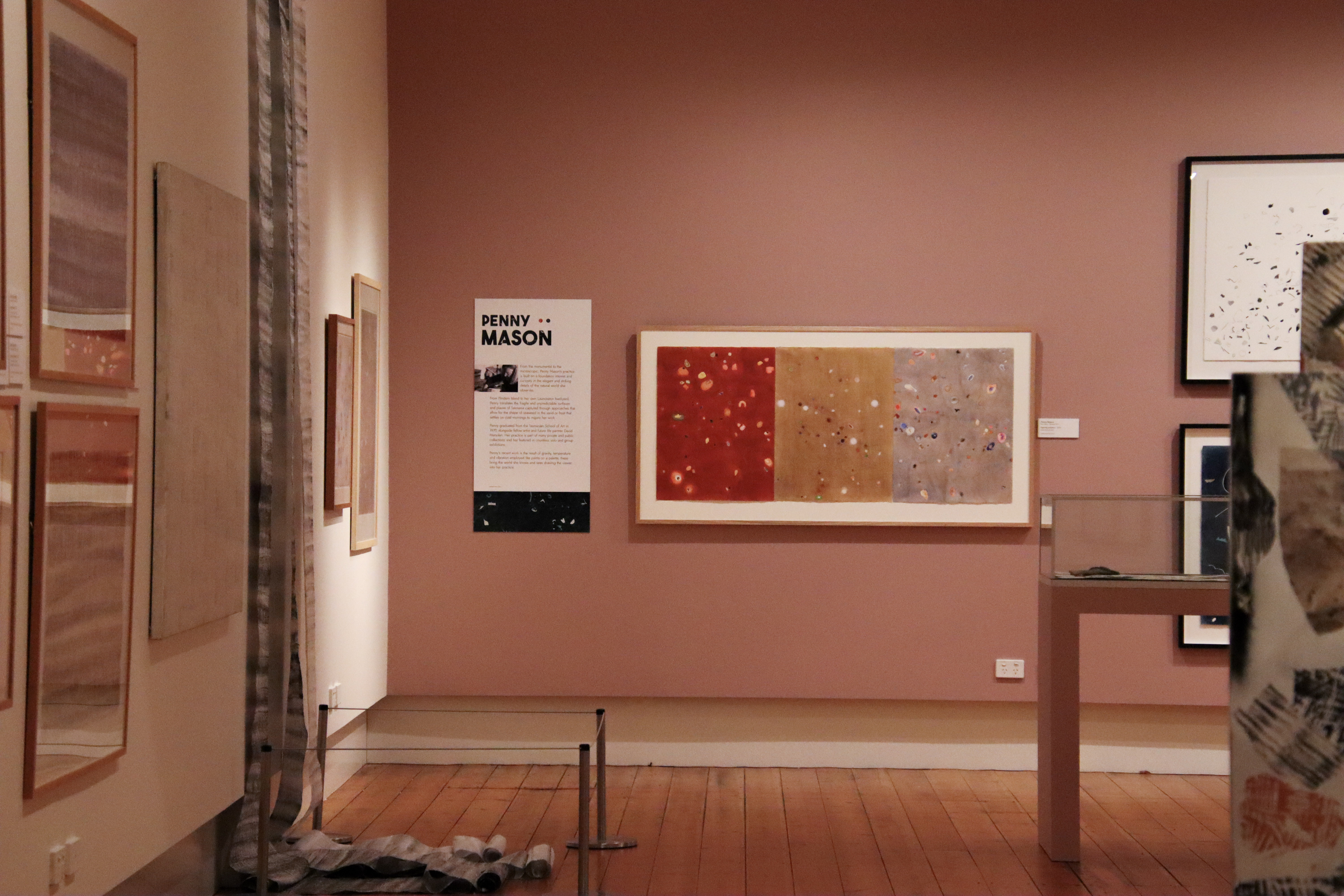
Mason | Marsden explores the 45+ year practice of Tasmanian artists, educators and partners Penny Mason and David Marsden.  

First meeting at art school in the 60’s, their art practice has evolved over the years, defining distinct and recognisable individual styles. 

Their journey as educators in Tasmania has been highly influential, inspiring many students studying the arts across the State.  

While sitting in the kitchen of their home/studio in Launceston, Penny begins the process of starting a new work by explaining the sequence of her methods.  

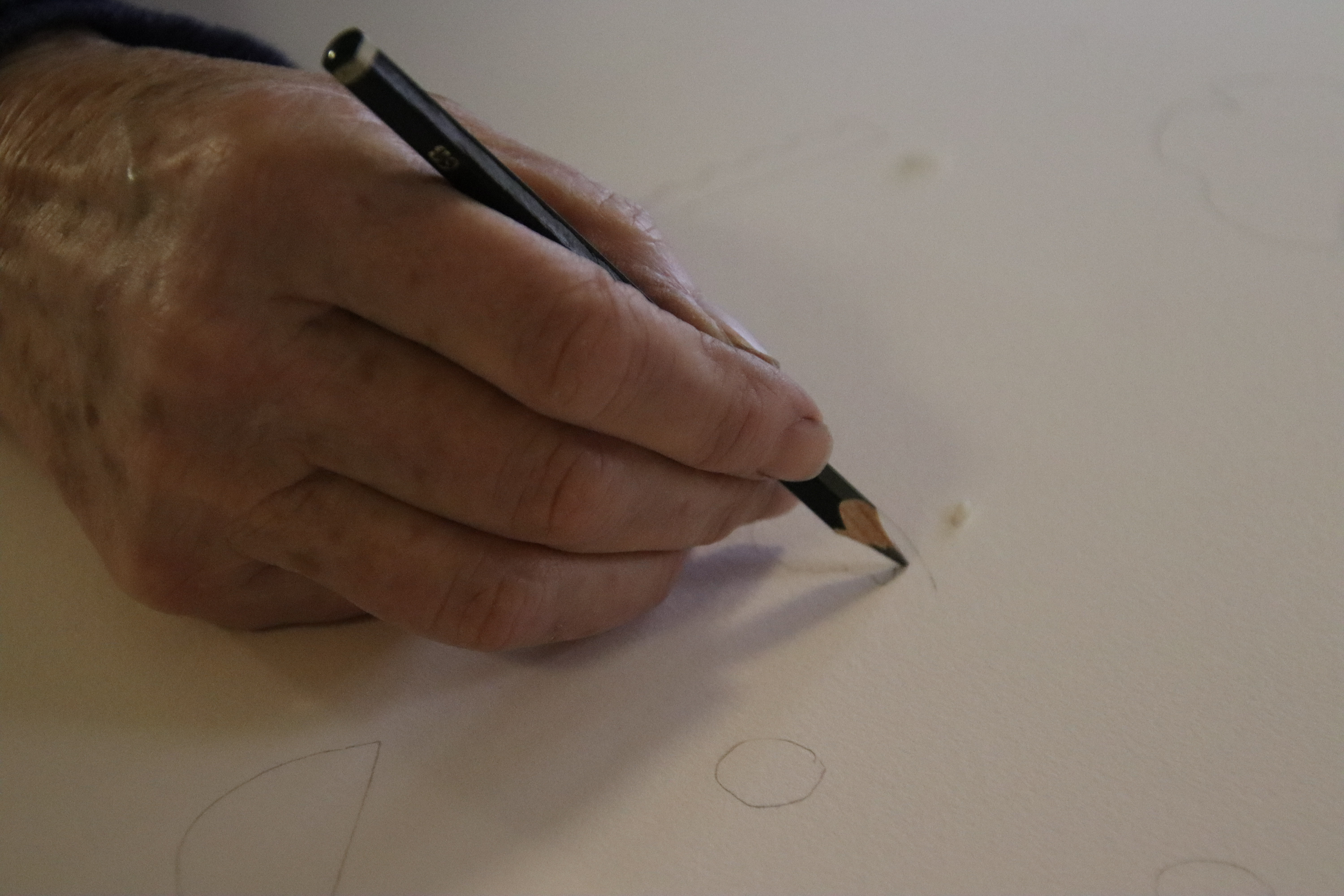
“When I set up the composition of a piece, I throw down rice quite randomly to act as indicators for the placement of details,” Penny said.  

“I often refer to earlier work, a piece that’s on the studio wall or from earlier sketches. I often use the same or similar shapes again and again. 

“This repertoire of shapes are often drawn from things that I've spotted on walks, random objects on the ground, but also contours of different horizons—for example, the profile of Tamar Island often appears. 

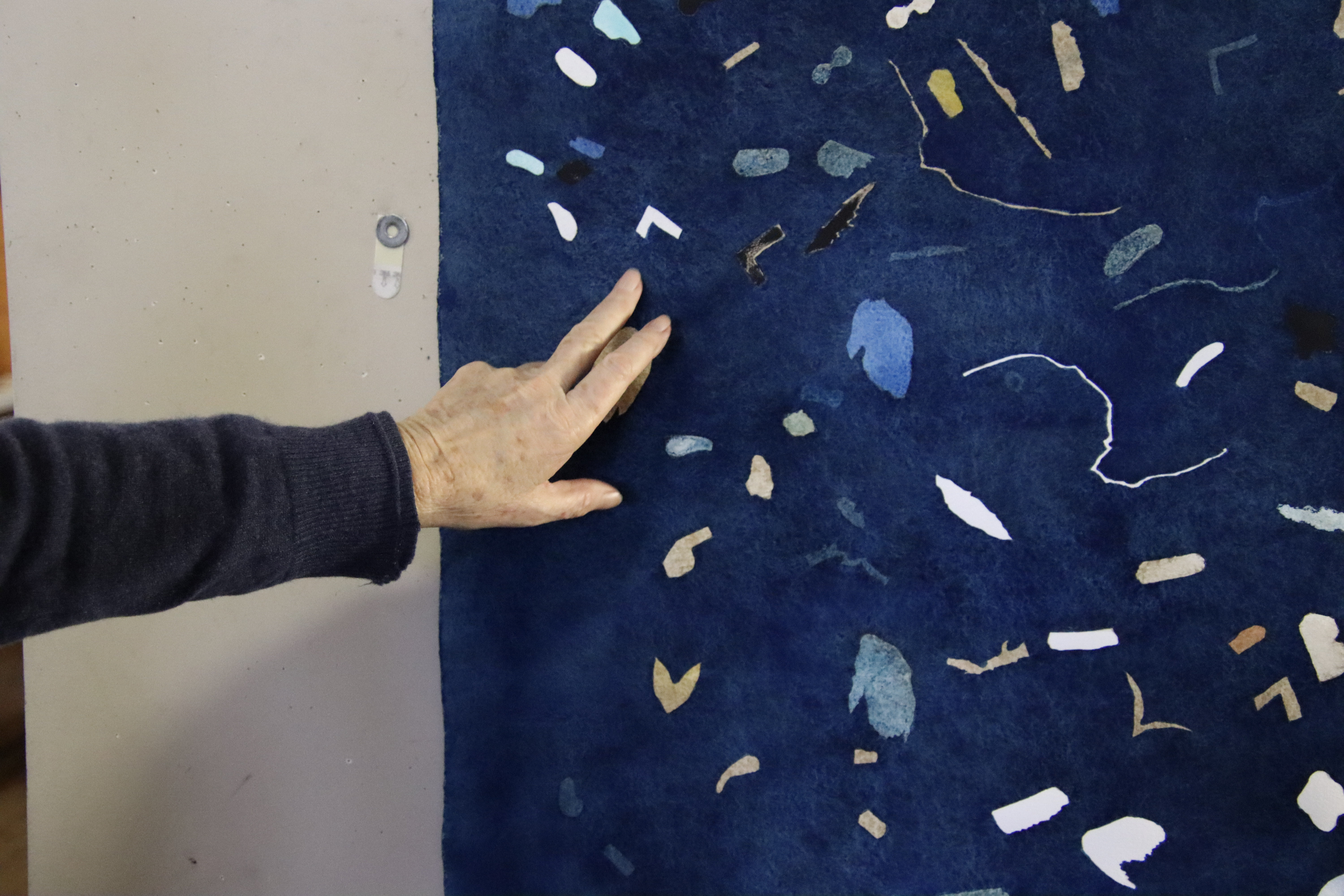
“Often these shapes appear pre-consciously, I might recognise a recurring motif long after its first use. For example, the ‘L’ shape resembles a space marker for parking spots, an everyday observation that I have only recently remarked. 

Penny pointing to an ‘L’ shape parking space marker. In this work you can also see fragments of foliage, a disembodied wing, and Tamar Island.

Image: Penny pointing to an ‘L’ shape parking space marker. In this work you can also see fragments of foliage, a disembodied wing, and Tamar Island.

When asked about the placement of shapes and markers within her work, Penny said it’s all about striking a balance between a satisfying composition and the randomness of objects in the landscape. 

“If you think of walking along on the beach, and seeing the waves wash in and re-arranging the rocks and shells on the sand, and everything looks just right; and then another wave comes in only to do the same thing again and everything still looks just right.” 

“In a way throwing down rice replicates this process—it’s working in a way of exploring the possibilities of composition, and it keeps me moving.” 

Image: rice markers used as a guide for composition.

Image: rice markers used as a guide for composition.  

Once the markers have been defined within the paper, the next step of Penny’s art is to prepare the paper.  

“A key part of the process is to get the paper very flat. This is a technique that has evolved over time.” 

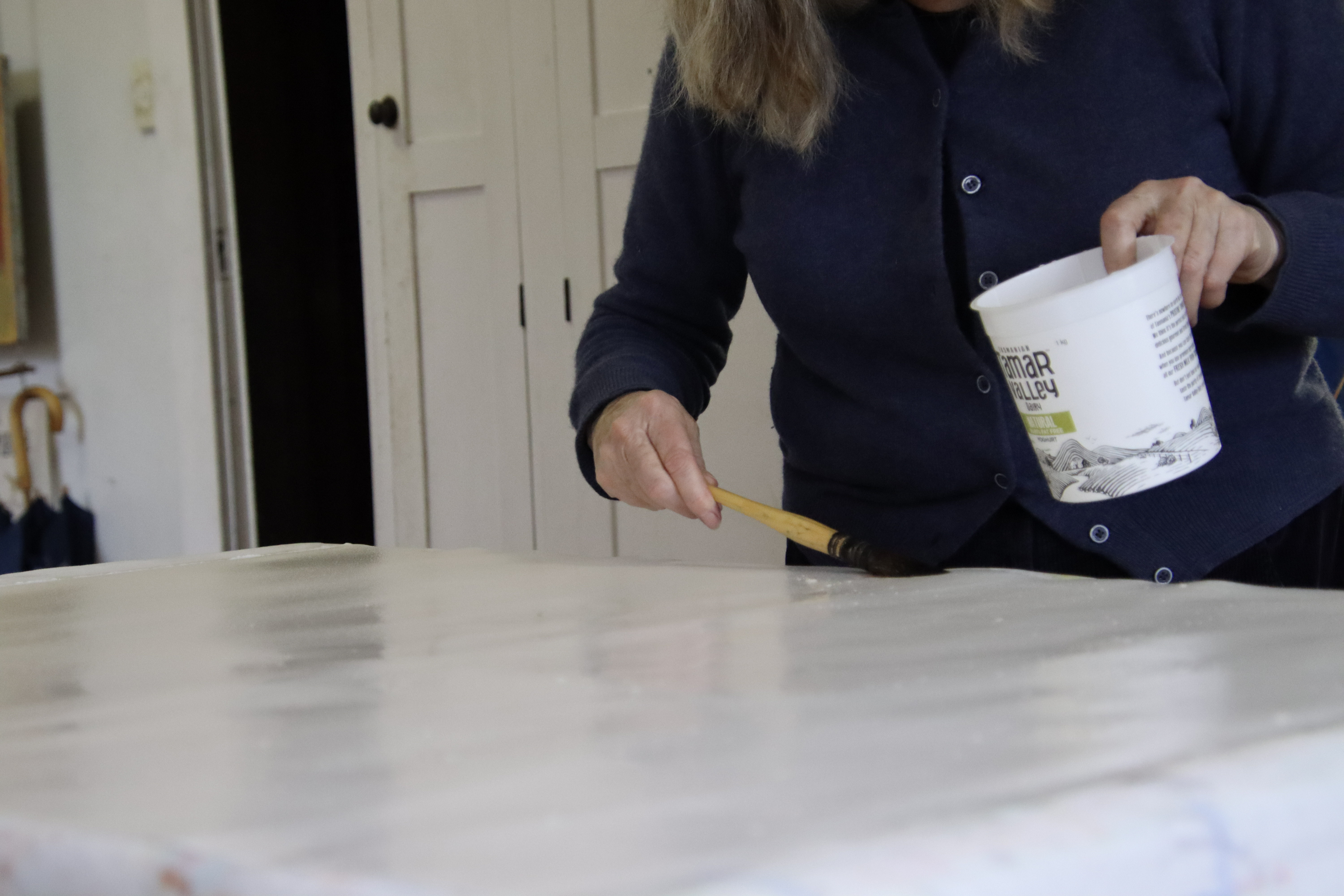
“The image is going to go face down, and I'll paint the back with a mixture of water and very diluted glue.” 

“I then let this sit for about 10 minutes before putting another coat on.” 

Image: applying water to the back of paper.

Image: applying water to the back of paper. 

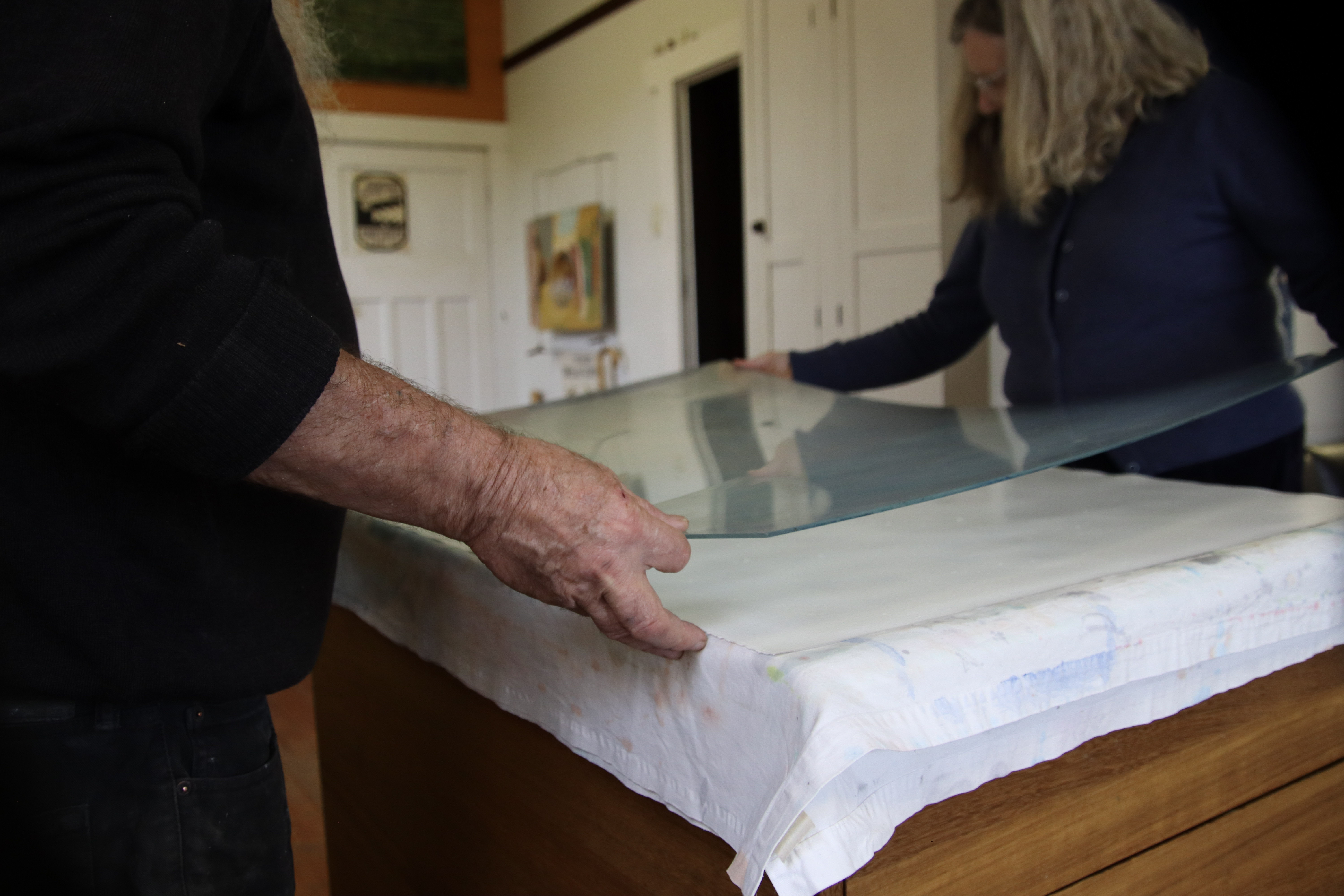
“After this is done, I'll stick this work to a sheet of acrylic to stop the paper from buckling. Sometimes the bucking can be nice, but if you want the work to be quite flat, this stops that from happening and allows you to have more control over the end result.” 

“Some works have three or four layers of colour, and I'll repeat this process between layers of colour, leaving the work for a few days to dry each time.” 

Image: paper preparation—acetate sheet being lowered on to wet paper.

Image: paper preparation—acetate sheet being lowered on to wet paper.

Image: first layer of paint being applied leaving details as negative spaces.

Image: first layer of paint being applied leaving details as negative spaces.  

When asked about her creative process, Penny said it’s important to experiment with different methods.   

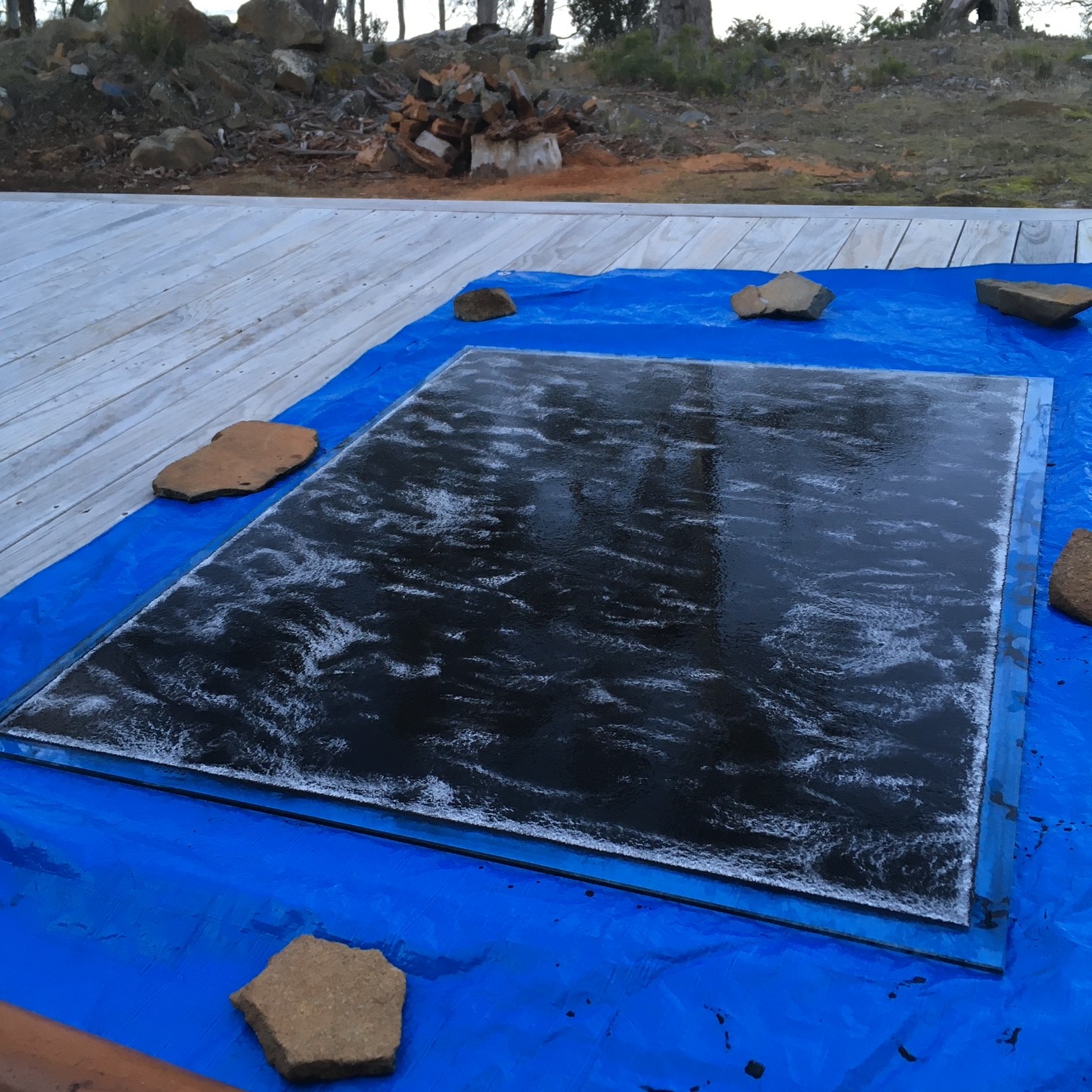
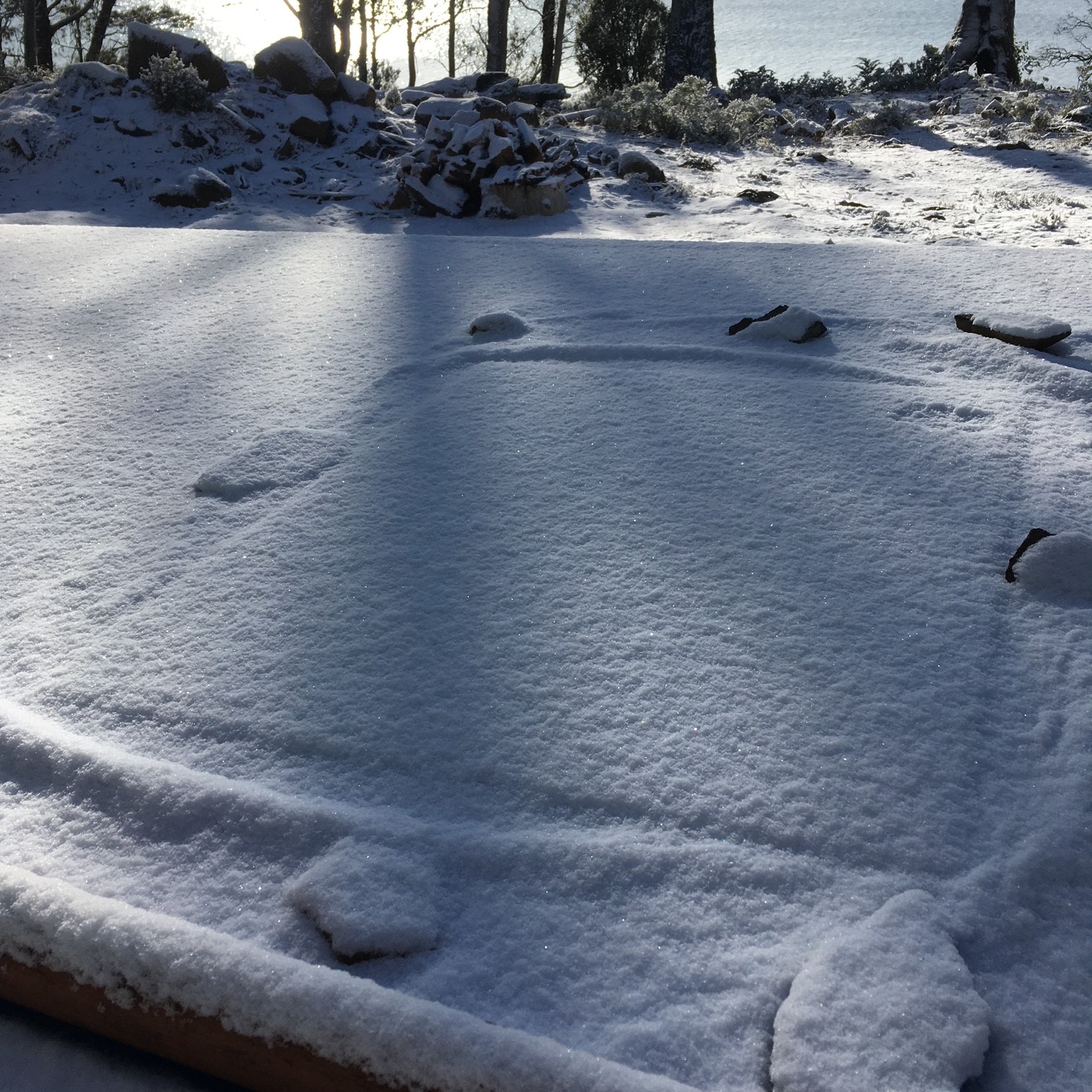
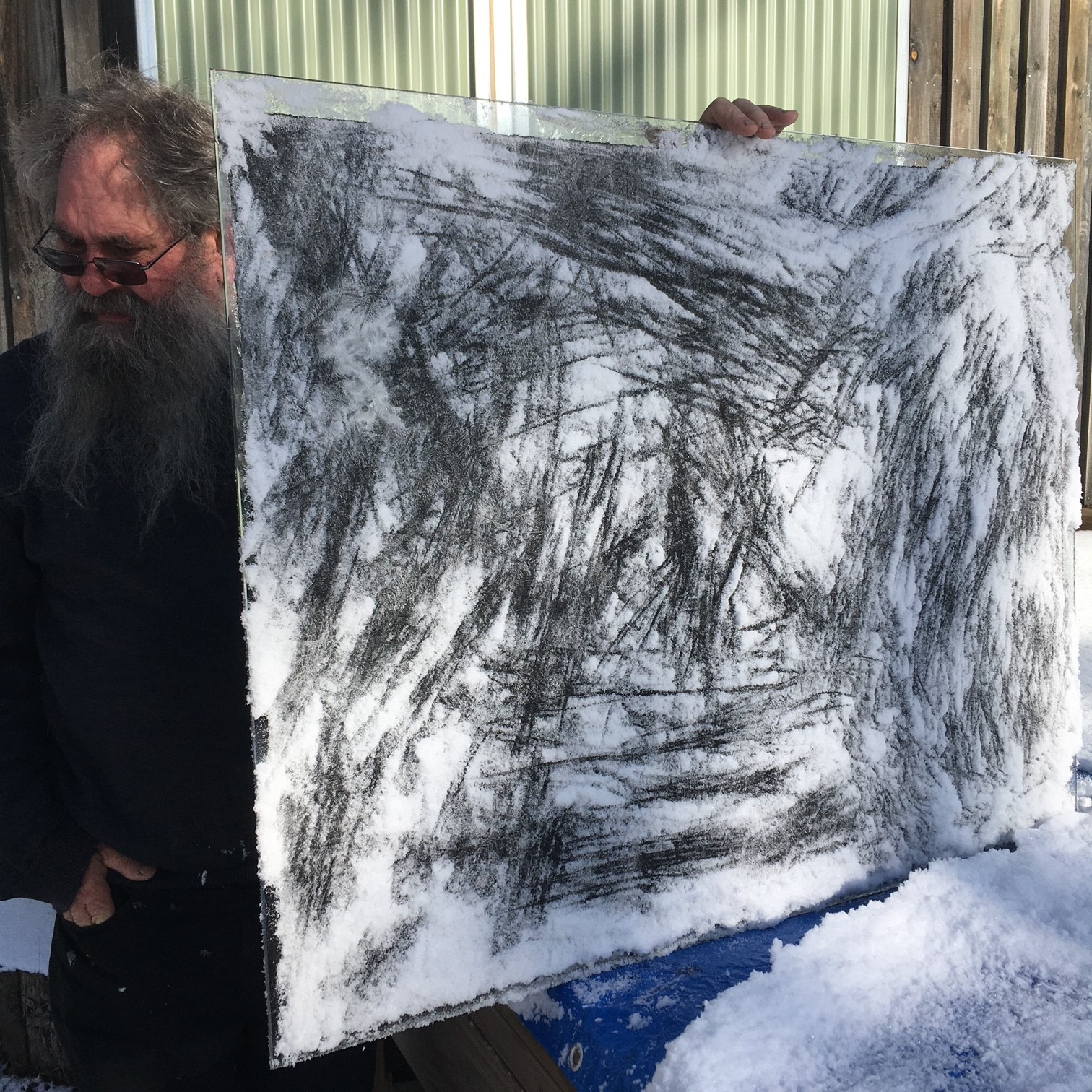
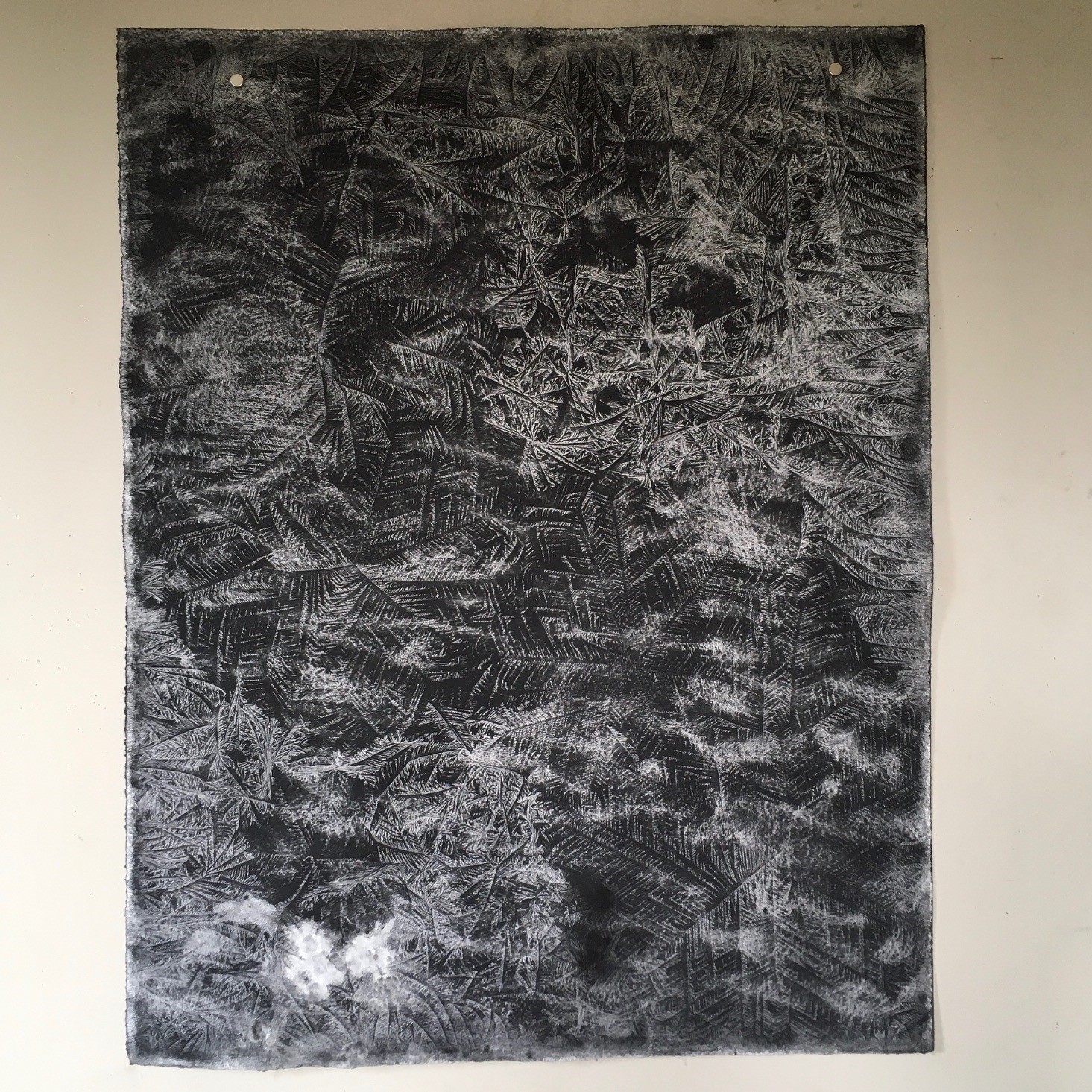
“For example, I work with frost in some of my works,” Penny said. 

“I glue the paper to a sheet of glass, and then apply paint in the late evening. As the temperature drops, a range of patterns of frost emerge, it’s a very hit and miss process, dependant on dew point, whether in fact there is a rain, frost or snow. Sometimes all of these events occur with surprisingly ordered patterns emerging. An example of this process is below.” 

Images: the process of frost art.

While chatting, Penny explains that her kitchen is the ideal studio space for her art, all thanks to the variation of light throughout the day.  

“I have a studio space here at the house, up the back of the property, but it’s really used as storage.” 

“I like working throughout different spots in the house, to get variations in light and breeze.” 

 “Watercolour works differently in different environments, and if it’s light and breezy, it can do some unexpected things. On days where the temperature is cooler, I can control the colour a lot more.” 

“Another aspect of watercolour is its tendency to granulate in response to vibration producing fields of texture reminiscent of sand, clouds, and deep whirling space.” 

“I use Daniel Smith watercolours, many shades of which are formulated to granulate.” 

Mason Marsden Exhibition at Queen Victoria Museum and Art Gallery with Penny Mason and David Marsden

Image: Mason | Marsden exhibition at the Queen Victoria Art Gallery at Royal Park (2 Wellington Street, Launceston).

“The exhibition Mason | Marsden traces our practice back to 1975 and includes reference to the influence of teaching on our work as well as our involvement in several artist-run galleries in Launceston.” 

Mason | Marsden is now showing at the Art Gallery at Royal Park until 16 July 2023.  

Thursday, July 13, 2023

HOUSING FOR HOMEMAKING: YES PLEASE IN TASMANIA


Households across Australia are struggling with soaring energy and housing costs and a lack of housing options. Mixed with a climate crisis, economic volatility and social inequality, it’s a potent set of policy problems. Australia needs a circuit-breaker – a bold national project to tackle the climate crisis and support households by shifting to a more sustainable housing industry.
This is a project based on circular economy principles. The emphasis is on reducing materials and resources, optimising building lifespan, designing for reuse and zero waste, and regenerating nature. By getting the most out of finite resources, we can minimise waste and shrink our carbon footprint.
Our research for the Australian Housing and Urban Research Institute (AHURI) applies these principles to housing. We developed a comprehensive strategy for the sector’s transition to a circular economy. It gives priority to local jobs, access to affordable housing, resilient and functional design, and carbon-neutral, energy-efficient operation.
Read more: Building activity produces 18% of emissions and a shocking 40% of our landfill waste. We must move to a circular economy – here’s how
Independent, free and evidence-based.
Solving two problems at once
The circular economy offers answers to the dual challenges of housing affordability and sustainability. These solutions work across households, renters and owners.
Both the climate crisis and the human right to adequate housing demand urgent policy responses. Despite this, new energy-efficiency standards that the nation’s building ministers had agreed would take effect in October this year have since been delayed in a majority of states.
Standards are the key to unlocking the shift needed to deliver housing that is both affordable and sustainable. In combination with fiscal and financial policy frameworks, business support schemes and education and training, the housing industry can develop its capacity to embrace and exceed standards. Australian households and the planet will benefit.
Read more: 7-star housing is a step towards zero carbon – but there's much more to do, starting with existing homes
How can Australia lift its game?
Housing policymakers across Asia and Europe are actively pursuing circular economy goals. As a result, Australia can learn from a wide range of circular economy approaches. Using better designs, techniques and materials, we can readily reduce the carbon footprint of our housing.
As the AHURI report details, a step change of comprehensive housing reforms that lead to more affordable housing and energy bills can also deliver greater resilience and social justice. The strategy identifies four areas of reform:
assign a higher value to the sustainability of housing
shift market processes
tilt investment flows by providing incentives for circular housing designs and projects
build the sector’s capacities to deliver sustainable outcomes.
The four areas of reform in a national circular economy housing strategy. Informing a strategy for circular economy housing in Australia/AHURI, Author provided
Read more: Our buildings are driving us closer to 'climate hell' – how do we get back on course to net zero?
Our research also recognises the specific forms of housing and the supply chains of materials to build them. These forms include residential neighbourhoods and precincts, new and renovated apartments, and social housing.
Internationally, we see a growing number of “eco-precincts” – walkable, sustainable, mixed-use developments. However, these are still seen as niche experiments, individual and not joined together across neighbourhoods.
Australian apartment building standards also leave much room for improvement. Robust and specific regulations to embed the circular economy in the construction, use and reuse of apartment buildings would provide clarity for the industry.
Apartment projects typically involve major developers and lenders. As a result, success with circular economy practices in this part of the housing sector can be a catalyst for adopting them more widely.
And because a high proportion of apartments are rented in Australia, higher energy standards for rental properties can help counter increasing energy poverty.
In social housing, tenant preferences are rarely considered in sustainable retrofits. Circular economy retrofitting delivers benefits for both landlords and tenants, through better design and lower bills.
Energy efficiency and alternative energy technologies have largely driven sustainable retrofit activity in Australia. Less attention has been paid to other circular economy housing priorities. Much more work must be done to extend housing lifespans and ensure passive design as standard practice, drawing on natural sources of heating and cooling such as sunshine and ventilation.
Read more: Australia is facing a 450,000-tonne mountain of used solar panels. Here's how to turn it into a valuable asset
We lack adequate data tracking material stocks and flows through the housing sector, including for retrofits. This applies to both new and recycled/reused materials in the construction and demolition waste streams.
Our analysis shows the use of concrete in housing continues to increase. This means concrete-related emissions are increasing too. Better data systems to track material flows would give us a clearer picture of where to target efforts to reduce embodied carbon in housing.
Read more: A third of our waste comes from buildings. This one's designed for reuse and cuts emissions by 88%
Towards a national strategy
Radical decarbonisation is needed. It won’t happen without big shifts in practices and materials.
Circular economy housing is a social project as much as a regulatory reform. Success depends on buy-in to the whole process across all levels of government, civil society, private sector and education and training institutions.
Simply relying on market demand to drive the supply of circular goods and services neglects the nature of current supply chains and the weakness of consumer voices. In particular, the one in three households that are tenants have little say in how sustainable their housing is. Stronger partnerships between governments, private developers and local communities are needed to deliver the scale of change required.
The housing industry can step up, with the support of policy incentives, to embrace leading circular economy practice. Housing has a big role to play in the economy-wide changes needed to achieve sustainable use of materials and net-zero emissions.


Wednesday, July 12, 2023

AN OPEN LETTER TO AUSTRALIAN COUNCILS, INCLUDING SUNSHINE COAST COUNCIL ... PLUS THE TASMANIAN MINISTER FOR HOUSING, CITY OF LAUNCESTON COUNCIL,ET AL

As someone who works full time in the Tiny House industry, I wanted to offer a perspective on the impact of this industry on the housing crisis that you may not otherwise have access to.

There’s a LOT happening behind the scenes with dozens of councils right now. Some have just opened their doors to Tiny House residents , like Esperance (WA), Mount Alexander Shire (Vic), and Surf Coast (also Vic). Others are currently revisiting their planning guidelines with a view to allowing Tinies for long term occupation.
But still more are sitting back waiting and watching what other councils are doing, trying to decide when might be a suitable time to start seriously considering Tinies as living options also. It’s why you joined this group, isn’t it?
I’m here to tell you- THAT TIME IS NOW.
I am just one of the key figures in the industry who hear real life stories daily of those struggling with housing insecurity. These aren’t small numbers- and I’m just one of the touch points these people have!
Homelessness is no longer purely the plight of the minority, the unemployed or people struggling with addiction.
The worst housing crisis Australia has ever seen is primarily affecting women.
I’ve spoken with HUNDREDS of single mums, semi/retired women and divorcees whose main focus every day is ensuring they have a stable roof over their heads beyond next week.
These women are being told by government departments to register for public housing, where even “high priority” cases are sometimes waiting more than FIVE YEARS for a home!
In the meantime, governments have no issue with you living in a tent, or your car. Can you imagine getting dressed and ready for work in the backseat of your Hyundai every morning?
But if you’re one of the ones resourceful enough to buy a Tiny House or a caravan to house yourself, you’re evicted very publicly, like you’re a criminal for daring come up with your own solution, and told to register for public housing.
This is NOT OK.
Tiny Houses may not be a long term or forever solution to the housing epidemic for every single person, but when they’re right here right now providing safe shelter to TENS OF THOUSANDS, myself and many of my friends included, how can you deny them?
WHAT IF- in your next election campaign, you could tell voters that you enabled homes for THOUSANDS of vulnerable community members- at ZERO COST to the taxpayer?
If you’re looking to secure your political future and stay in office long enough to make lasting change- the decision you have the opportunity to make here is a no-brainer.
Mount Alexander Shire Council last month made the landmark decision to allow residents to live in a Tiny House permanently, with no permit requirement, on private land where there is an existing primary dwelling (read about it here: https://bit.ly/LocalLaw13)
Mayor Rosie Annear has stated “A lot of us on the council couldn’t live with ourselves if we didn’t do something to try to make things better.”
Your constituents (ie the people who pay your salary) deserve your compassion, not the big stick.
You have the power to change TENS of thousands of lives with one simple, cost-free decision. You have the power to be a shining example for other councils, and demonstrate what true leadership really means.
You joined council to make a positive impact on the world.
NOW is the chance of a lifetime to do just that.
Please take it 🙏🏻
xBry
PSA FOR THE GENERAL PUBLIC

* I understand your frustrations where councils are concerned, but please refrain from attacking them in comments. Compassion and education will lead the way, not blame and hatred

* Please tag your local councillor and invite them to the group/page for awareness